I just love this series. A gentle white person guides other white people (like me) through some amazing (and awful) history without haranguing anybody.
«If you witness white folks doing problematic things, speak up with compassion to take the burden off Black folks and our siblings of color whenever appropriate. Seek to engage rather than escalate, so that it can be a learning moment rather than a disruption.»
I had a thought / was reminded of a thought I had some time ago.
I’m thinking it is the job of white people in the (global) West to do two things: (1) educate ourselves, to the best of our ability, and (2) educate each other, again, to the best of our abilities.
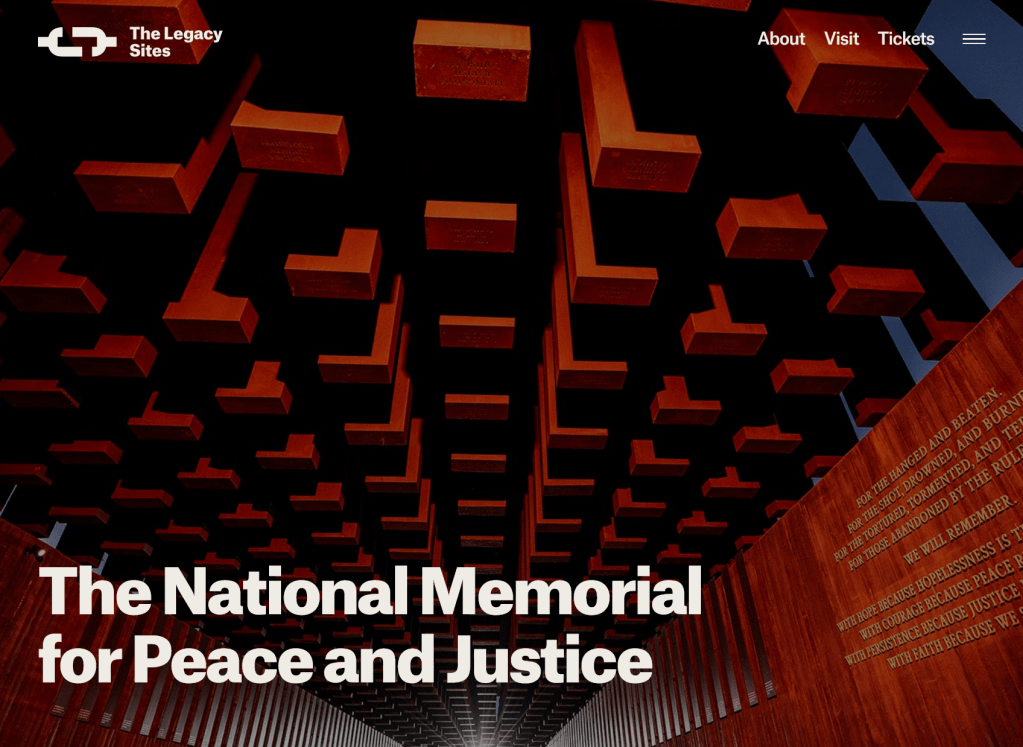
I had the privilege of travelling with a multi-racial group to Selma, Alabama, for the occasion of the 60th anniversary of the Selma bridge crossing. Part of our sojourn included a visit to the Equal Justice Initiative Lynching Memorial, https://legacysites.eji.org/about/memorial/.
When you enter the Memorial, you are admonished to show respect, similarly to how the referenced blog post admonishes us to show respect. Several of us (Black and white) peeled off to walk the grounds in solitude. A group of us (Black, as I recall) walked the grounds together. They had some youths among them, but the group as a whole (and they were not the only such group I saw that day) was basically clowning around, pretty much in apparent contravention of the preceding admonishment. (Listen to me, with my polysyllabic words.) At the time, it seemed to me to be basically disrespectful, and evidence that nothing was being learned.
I overheard a couple who appeared to be Asian, speaking to one another about the disrespect and loudness of the Black groups, a sentiment I agreed with at the time. I know nothing about them. They had no accent, and they had that easy American judgmental air, so I’m going to assume they are as American as I am. And that they had come to the Memorial with the same good intentions as I did.
But later, I was thinking. It’s a somber place, with the hanging markers. I imagine those markers both convey threat and engender anger (“rage” might be a better word), for Black visitors. In the context, Black joy might be an appropriate response. Rejection of threat. Celebration of the strength of the group. Possibly a more healthy response than rage. (I don’t know; I’m not Black. Rage is certainly justified and appropriate.) And also: who am I to assume that no learning is occurring? Humans are capable of doing more than one thing at once.
So, this constitutes a missed opportunity on my part (yet another, in a long line), for multiple reasons. (1) I hadn’t formed these thoughts at the time. (It’s worth pointing out that I might not have, were it not for this experience.) And (2) even if I had, would I have spoken to that couple? Sufficiently gently and diplomatically? (Honey versus vinegar.)
Well, I can always write a blog post. To the set of white people (including -adjacent, honorary, or otherwise) who read this blog post and find themselves at a place of Black remembrance and who see something similar (I’m guessing the cardinality of that set is just about zero, but you never know): when you see this behavior, consider chilling out. Many responses are legitimate.
«“[Medicaid] State adoption decisions are positively related to white opinion and do not respond to nonwhite support levels,” they [Grogan and Park] concluded.»
#theSumOfUs
I.e., it’s up to us white people, again.
Wait, that sounds bad. What I mean is, we need to act. We can’t just wait for Black people to ask hard enough while we do nothing.
«Experts on the way racialized thinking operates would read the same comments and see the fingerprints of racism all over them. In studying the same anti-Obama sentiment during the same period, psychologist Eric Knowles and his colleagues devised experiments to minimize the silencing impact of social desirability (that is, giving answers you know society wants you to give); to analyze based on implicit, not explicit, bias; and to control for other rationales such as ideology and partisanship. With all that stripped away, racial prejudice remained. They explained, “People may fail to report the influence of race on their judgments, not because such an influence is absent, but because they are unaware of it—and might not acknowledge it even if they were aware of it.”»
«The federal government in 1934 endorsed such segregation by refusing to underwrite mortgages for homes unless a racial covenant was in place. Then in 1948, following activism from black Americans, the US Supreme Court unanimously ruled these covenants unenforceable.»
Did not know. ☹️ I had assumed it was just individual HOA types, not THE FEDERAL GOVERNMENT.
On a somewhat related note: I wonder just how much our supreme court is going to roll back.
Wow, this seems pretty poisonous. Enshrining cash bail in the state constitution and making it harsher than before, if I understand correctly. Why is that necessary? How will it not disproportionately harm Black people in application? Was that just to drive conservative turnout up? Why did they pass?
This just seems like Racism Without Racists, which is the title of a book by Eduardo Bonilla-Silva (which I won’t link because three links is too many).
«”A majority of our sample tends to think that we’ve made steady progress towards greater equality in wealth between families, so between black and white families,” he says. “That is totally inconsistent with reality.”
Most of those he surveyed thought that today, for every $100 dollars white families have, Black families have about $90. In fact, the racial wealth gap is exponentially larger. Given its magnitude, and the recent intense focus on racial justice around the country, Kraus calls this disconnect a kind of “collective willful ignorance.”»
Could Rasmussen, a polling company, have been stupid enough to include it in a poll? Their article seems to be behind a paywall, so I can’t read the wording of the question.
Wow, they used “woke” and they put it in scare quotes. This is garbage.
«Despite years of progressive activism, a majority of Americans still don’t buy into the “woke” narrative that white people have a monopoly on racism.»
 Here, Read This