https://www.thebulwark.com/p/how-to-drive-a-stake-through-the-heart-of-trumpism
I really hate to post something by *The Bulwark*, a “conservative”* outlet that, as far as I know, has never and will never acknowledge the role “conservatives” played in getting us to this place in history, but… it raises some good points.
*Yeah, quotes. I believe “conservative” is a fig-leaf for racism and sexism, and has always been. It’s not “fiscal responsibility”, it’s “let’s not spend money on Head Start.” The tiny slice of our budget aimed at improving the state of the marginalized and correcting injustices is not a waste of money, but “conservatives” would have you believe it is. Fiscal responsibility includes raising taxes to pay for all the wild crap we’ve put in our budget, like front-loading military expenditures and the interest on the national debt. If we want to subsidize petroleum consumption, let’s pay for it.
Ok, the whole thing:
title: “How to Drive a Stake Through the Heart of Trumpism”
source: “https://www.thebulwark.com/p/how-to-drive-a-stake-through-the-heart-of-trumpism”
author:
- “[[Jonathan V. Last]]”
published: 2026-04-15
created: 2026-04-17
description: “Victory is only the beginning.”
tags:
– “clippings”
Victory is only the beginning.
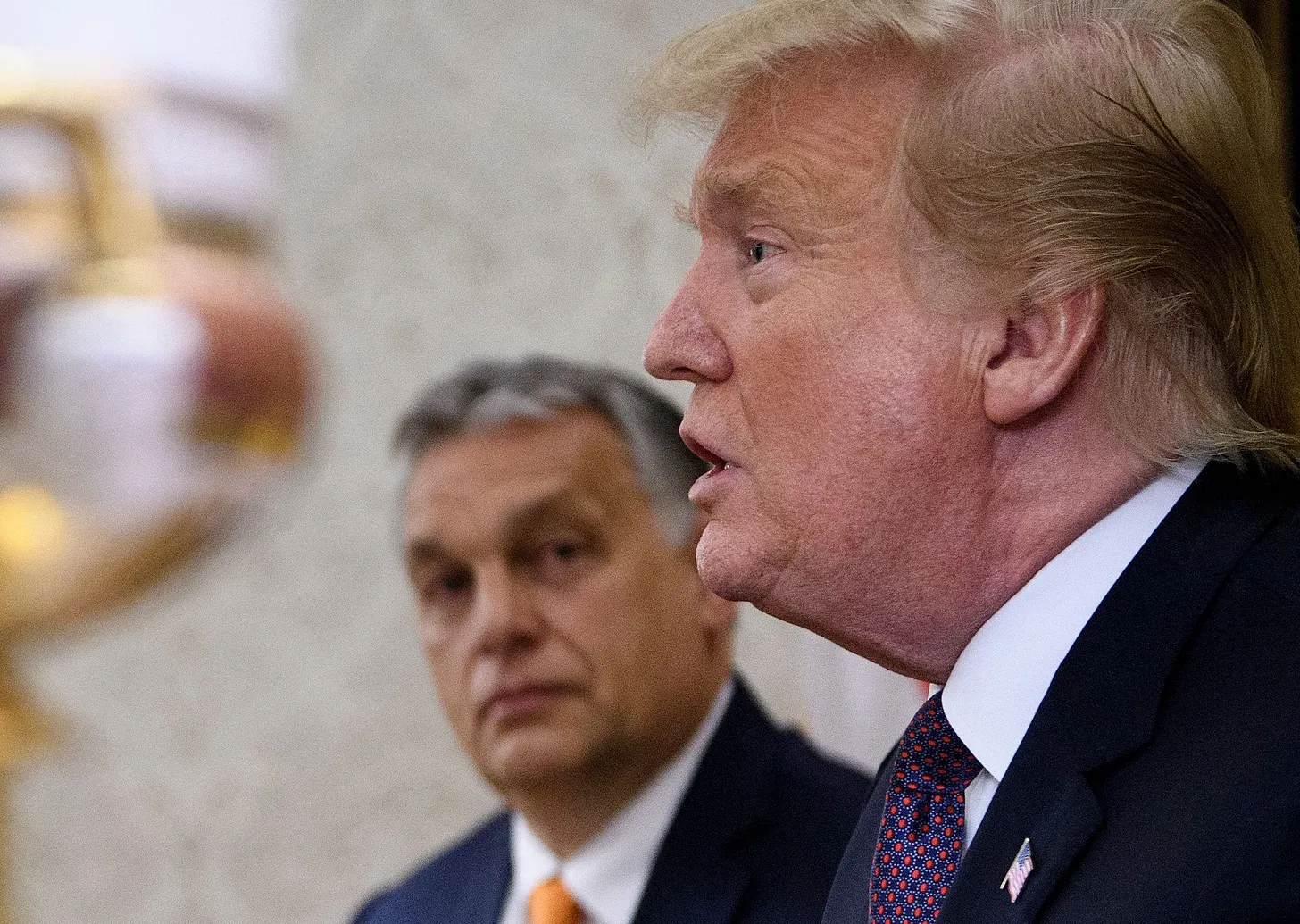
President Donald Trump (right) and Hungarian Prime Minister Viktor Orbán in the Oval Office in 2019. (Brendan Smialowski / AFP via Getty Images)
Yesterday I gave you a long exegesis on how Victor Orbán legally turned Hungary into a competitive autocracy. The short version is that Hungarian democracy—like American democracy—was run on the honor system. I hope you’ll read the long version anyway.
Today I want to talk about how the incoming Hungarian government is thinking about structural reforms to take their democracy off of the honor system. We should pay attention to this because if we’re lucky enough to throw off Trumpism in America, we will face a choice.
Should the American opposition party focus on “the future” and “kitchen-table issues”?
Or should they go after the retreating authoritarians hammer-and-tongs and use power to reform the structural weaknesses that allowed Trumpism to flourish?
After we talk about what the Hungarians are looking at, we’ll talk about some of the things that should be on the table in a post-Trump America.
Warning: We’re in a late republican period. If we’re going to push back against it, we’re going to have to get pretty wild and pretty far out there and go in directions that a lot of liberals right now are uncomfortable with.[^1]
Let’s go.
1. Reform: Hungarian-stizz
Yesterday we talked about Orbán’s various machinations after being elected in 2010. He passed an entirely new constitution on a party-line vote after winning an election in which doing such a thing was never even mentioned.
This was bad! Norms! Radical action! No bueno!
But what is Péter Magyar’s Tisza party supposed to do now? Would we have them not pass constitutional amendments—or even a new constitution—to undo the damage Orbán did? Even if they can only pass them on party-line votes?
The full extent of Magyar’s plans for the constitution are unclear. So far as I can tell, the only reform he has definitely promised is an amendment capping a prime minister at two terms (eight years).
Is that enough? If the constitution can be amended by a two-thirds vote of parliament, then a future supermajority could simply rewrite the rule to allow a future strongman to continue in office.
My sense is that Magyar was purposefully vague on this subject. We’ll see soon how ambitious his plans for constitutional reform are.
Magyar has promised some legal (as opposed to constitutional) reforms. For example:
- Control of the Hungarian intelligence services will be relocated from the prime minister to the Ministry of the Interior.
- The Sovereign Protection Office— an Orbán creation that had access to tremendous amounts of personal data and a mandate to find and sanction Hungarians who were deemed to be enemies of the state—will be destroyed.
Magyar says he plans to reform the judiciary, which, as we discussed yesterday, has been turned into an arm of Fidesz. How will he do this?
Unclear.
Magyar also says he plans to empower the attorney general to be independent and to free the media and the universities. Again: The mechanisms he uses to achieve these goals will matter; we have no idea what they might be.
To my mind, the most significant change we know about is Magyar’s pledge to join the European Public Prosecutor’s Office. This ascension would give the E.U. jurisdiction to investigate and prosecute fraud and corruption inside Hungary.
Meaning that if Orbán, his apparatchiks, and/or his cronies committed crimes during their reign, they could be held criminally accountable.
Which seems like a very big deal.
2. Reform or Accountability?
My thesis is that in order to make the resurgence of authoritarianism harder, a liberal democracy must achieve both accountability and reform. To do one without the other increases vulnerability down the line.
But what if you can’t have both? What if political resources are finite and you have to choose between them?
“Accountability” and “reform” aren’t buttons you push. They are fights you wage because there will always be a segment of the population that wants illiberalism.
We have been talking about the enormous victory that Magyar’s Tisza party won over Orbán’s Fidesz because of the number of seats Tisza ended up with in parliament. The actual vote totals were closer.
You will recall that Orbán passed a number of laws designed to disproportionately increase his hold on power. One of them was a regime called “ winner compensation.” You can read the ins and outs of it if you like, but the end result is that “winner compensation” had the effect of magnifying victories to the point that if the votes are geographically distributed in just the right way, even a plurality victory in the popular vote can get a supermajority of seats in parliament.
It was this mechanism that made Magyar’s victory look so substantial. Tisza won (according to the latest count) 137 seats in the 199-seat parliament —a 68.8 percent majority.
But of the actual votes cast? That was much closer.
Tisza won 52.10 percent of the popular vote to Fidesz-KDNP’s 39.55 percent.
Don’t get me wrong: This is a tremendous achievement, given how Orbán had stacked the deck.
But it means that even with:
- a miserable economy
- rampant, obvious corruption
- scandal after scandal
- proven interference from Russia
- an old, tired candidate with literally no campaign message aside from “But Zelensky!”
- and a program of government repression that every Hungarian saw and understood
… more than a third of voters chose Orbán.[^2]
Every action Tisza takes will be a fight against entrenched Orbánists in the government (and especially the judiciary) and a meaningful base of popular opposition.
How is a liberal democracy supposed to function, in the long run, if 2 out of every 5 voters wants illiberalism?
Which brings us to the lessons we should be studying here.
3. Living in America
We need to come to terms with the fact that the U.S. Constitution is a flawed system. I don’t mean morally or philosophically flawed. I mean mechanically flawed. It contains mechanisms that do not—and have never—functioned as designed.
For instance, the Constitution has a remedy for a chief executive who is a criminal: impeachment. But impeachment does not work. We can say fairly definitively that it cannot work. It’s like a car with square wheels. If impeachment was a workable mechanism for removing a corrupt, criminal, or traitorous president, then we would have removed at least one of those guys.
We have not. Ergo: Impeachment is a dead letter. (Ditto the Twenty-fifth Amendment as a mechanism for removing a president who does not want to go; ditto the Fourteenth Amendment’s Disqualification Clause.)
Another for-instance: The amendment process itself worked once upon a time, but it no longer appears to function.
I suppose people could argue the point, but I ask: Can you propose an amendment that three-quarters of the states would ratify today? Could you get three-quarters of the states to agree that ice cream is good?
I don’t think so. At the least, we can reasonably say that in our time it is not possible to amend the Constitution. Such ossification is a thing that happens in political and legal orders. We should not be surprised that it has happened to us.[^3]
Is it possible that, at some undefined point, future generations of America might be capable of passing another constitutional amendment? Maybe?
But in the here and now we need to confront a hard truth: Any problem that can only be reformed via constitutional amendment will not be reformed.
In a post-Trump America we have to start from the position of understanding that reform can only be accomplished via executive action or legislation and that reforms can only survive legal scrutiny if the Supreme Court is itself reformed.
So start with this question: What is legal? What reforms are allowable by the letter of the law?
- Kill the filibuster
- Expand the Supreme Court
- Grant statehood to the District of Columbia and (if its people so choose) Puerto Rico
- Legislate a prohibition against Schedule F
I am interested in other ideas you might have here. But with the caveat: It must be achievable by executive order or legislation. And I’d encourage you to be hard-headed about what is actually possible, even in a world without the filibuster. No flights of fancy, please.
If we defeat Trumpism we will need both reform and accountability. I am not convinced that the Democratic party (or the American people) are serious enough to demand either of them.
And I am almost certain that our political system is no longer vital enough to achieve both.
In the best-case scenario we will probably have to pick and choose a bit from each menu and hope that it’s enough to muddle through. Because there will be resistance from the substantial cohort of Americans who want illiberalism.
Which brings me to one final question: What if we can’t get some from each menu? What if the politics of the moment are so fraught that we’d be lucky to get either some reform or some accountability?
Which would you choose? Which do you think would be most effective in protecting liberalism?
Accountability for the people who tried to undermine American liberalism?
Or reform of the system that allowed them to gain and exercise power?
[^1]: That’s right. I said it.
[^2]: Seems important to underline that Magyar was not offering a dramatic contrast to Orbán’s populist policies. He was, essentially, a small-“l” liberal version of Orbán. So you can’t really say that Hungarian voters who chose Orbán this time did so because they were revolted by Magyar’s ideology.
No. People who voted for Orbán wanted the illiberalism. The illiberalism wasn’t a bug for Orbán’s voters; it was his biggest feature.
[^3]: I’m not certain that this is a bad thing? For instance, the Hungarian constitution seems so easy to amend that it is dangerous. Maybe the U.S. Constitution is too hard to amend? But I’m not sure there is a perfect answer.

