Sorry, Thom. Your brand is already pretty damn low.
GOP senator: Greene ‘dragging our brand down’ | The Hill
Leave a reply
Sorry, Thom. Your brand is already pretty damn low.
Interesting collection of graphs I ran across while googling:
https://www.c2es.org/content/international-emissions/
Update: Where does all that electricity go? A hint, but only for one country: https://www.epa.gov/ghgemissions/sources-greenhouse-gas-emissions
(Looks like it’s mostly residential and commercial.)
O btw, speaking of populism vs. accuracy, here’s something I emailed to somebody recently. Just occurred to me that it might be of general interest.
https://www.theatlantic.com/ideas/archive/2024/04/inflation-democrats-biden-interest-rates/678047/?gift=ly-h2TZGdDJyaoFv6n-KaceUMPblwSdcafGzpGratDA&utm_source=copy-link&utm_medium=social&utm_campaign=share
Here’s a bunch rudely-copied excerpts:
«The consumer price index for food rose 25 percent from 2019 to 2023. The jump in 2022 was the highest since the late 1970s. As of two years ago, Americans spent 11 percent of their disposable income on food, the highest share in three decades, according to the U.S. Department of Agriculture.
Food-price inflation falls most heavily on the poorest 20 percent of Americans, who spent nearly a third of their income on food in 2022, the latest year for which USDA data are available. By contrast, the highest-income fifth of households spent on average 8 percent. “If you are spending 25 to 30 percent of your income on food and prices have jumped 25 percent, you are in real pain,” Weber said.
Other staples of life have also grown more expensive. Gas prices have gone up by about 50 percent in the past four years. Fuel-oil prices jumped by more than half from March 2020 to March 2024. Home prices have gone up nearly 50 percent nationwide since the start of the pandemic; the ratio of home prices to income has reached an all-time high. Once-sharp increases in average rents nationwide have slowed but not reversed. The Joint Center for Housing Studies at Harvard reports that poor and working-class renters suffer disproportionate pain. “Among renter households with an annual income under $30,000, the median amount of money left over after paying for rent and utilities was just $310 a month,” the center found, adding that affordability is at an all-time low.
Then there’s the problem of money, which has become far more expensive to borrow. The Federal Reserve Board’s efforts to tamp down inflation by pushing up interest rates have exacted a painful toll on working- and middle-class Americans—a toll not captured by the inflation rate.
The average mortgage interest payment has increased threefold since 2021. The combination of high prices and high interest rates has shut many Americans out of homeownership altogether. High rates also hurt many people who already own homes: Interest rates on equity credit lines and loans, which many Americans use to pay for home repairs, college tuition, and larger purchases, more than doubled from January 2022 to July 2023. High interest rates punish low-income renters, too, by hampering local and state agencies from financing below-market-rate apartments.
In March 2022, before the Federal Reserve started raising rates in response to inflation, the average credit-card rate was 16.3 percent, according to Bankrate. Two years later, it sits above 20 percent.
All of this inflation-related misery has begun to catch the eye of the economics establishment. Recently, four researchers, including the International Monetary Fund economist Marijn Bolhuis and the former U.S. Treasury Secretary Lawrence Summers, released a National Bureau of Economic Research working paper noting that consumers are remarkably attuned to what’s going on. “Consumers, unlike modern economists, consider the cost of money part of their cost of living,” the authors write. Consumer unease about costs and borrowing, they say, is greater than at any time since the late 1970s and early ’80s. The authors developed an “alternative” consumer price index that more closely tracks actual costs felt by American consumers. The researchers claim that their preferred inflation index would explain most of why consumers feel more sour than official statistics would normally predict.»
https://www.publicnotice.co/p/two-party-system-isnt-the-problem-israel-england
This article ALONE is worth subscribing for.
Here’s an idea: a convention for fundamental open-source infrastructure projects with a small number of maintainers. In either McCook NE or North Platte NE (or both!), which just happen to be at the geographic center of the country.

Re Tom Cotton encouraging car drivers to run over Gaza protesters:
«The First Amendment to the United States Constitution guarantees free speech, and the degree to which incitement is protected speech is determined by the imminent lawless action test introduced by the 1969 Supreme Court decision in the case Brandenburg v. Ohio. The court ruled that incitement of events in the indefinite future was protected, but encouragement of “imminent” illegal acts was not protected. This “view reflects longstanding law and is shared by the Federalist Society, the American Civil Liberties Union, the Foundation for Individual Rights and Expression.”»
https://en.m.wikipedia.org/wiki/Incitement#United_States
Looks like he’s off the hook, and he knows it.
«“You don’t hear about these types of breaches coming out of other cloud service providers,” Meyers says.»
https://www.wired.com/story/the-us-government-has-a-microsoft-problem/
This is interesting. Among all the hoopla about RTO:
«5. Work-from-Home (WFH) Trends
Working from home appears to be a preferred benefit14 for former full-time office workers, and many firms now recognize WFH’s competitive advantages or are beginning to do so.15 This workplace trend suggests that U.S. firms are no more likely to go back to requiring full-time in-office work than to requiring full-time business attire for office workers. This means that many firms may be leasing more office space than they need—and if the WFH trend becomes permanent, firms will need to downsize their office space as their leases expire. This downsizing could result in a contraction of the office sector as significant as that of regional malls in the 2000s.16»
https://www.financialresearch.gov/the-ofr-blog/2023/06/01/five-office-sector-metrics-to-watch/
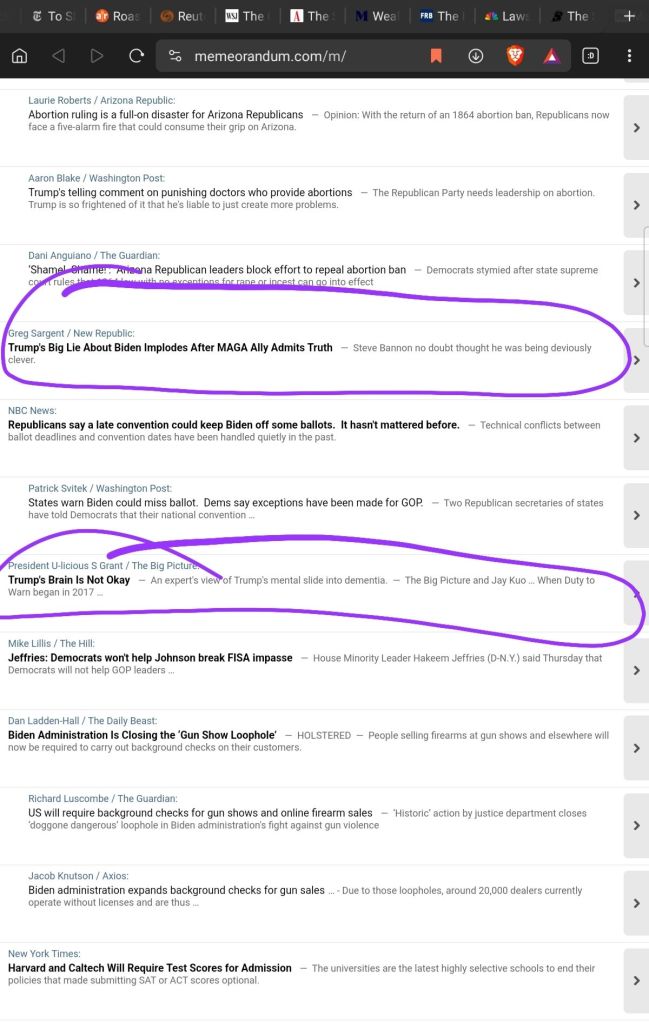
None of this matters. 50% of the US electorate will vote for him NO MATTER WHAT, because he represents what they want. That 50% is the problem, not Trump.
My neighbors. My co-workers. My relatives. The people I’m “friends” with on Facebook.
Because they want him to preserve their tax deductions.
«However, Germany is still heavily dependent on other countries for its energy supply, creating pricing issues for the embattled economy. The effects on German industry have been pronounced and, according to the RWE chief, are likely to be long-lasting.»
https://finance.yahoo.com/news/germany-set-permanently-pay-reliance-101957758.html
 Here, Read This