«“If you’re here illegally, expect to be removed,” said one. “This is the consequence of being in a nation with laws,”»
Due process? Hello?
«“If you’re here illegally, expect to be removed,” said one. “This is the consequence of being in a nation with laws,”»
Due process? Hello?
More Reagan/Republican stupidity. “The free market is better!” Right.
«During the 1980s, however, Congress and Ronald Reagan abandoned the regulated-competition approach. Reaganites argued that the FMC, which at the time had a budget of just $11.8 million, had become a bloated bureaucracy, and reasoned that the U.S. could achieve economic efficiency and lower shipping prices if ocean carriers were not required to treat all shippers equally. To that end, Congress passed a series of bills during the Reagan and Clinton administrations that stripped the FMC’s ability to regulate ocean-carrier cartels.
The first-order effect was a return to the destructive competition and underhanded exploitation that had characterized the early-20th-century market. As the rise of containerization led to ever larger ships, fixed costs grew. This increased carriers’ incentives to fill empty space on ships, even at steep discounts, because at least they would lose less money than if the space were unsold. Still, profits fell, and carriers turned to waves of mergers made possible by the federal government’s simultaneous retreat from antitrust enforcement. In the seven years after President Ronald Reagan signed the Shipping Act of 1984, seven major carriers were snapped up by the competition, compared with just one during the entire period from 1966 to 1983.
American-flag carriers, which had higher costs than foreign counterparts, were particularly hurt by the rate wars, especially after the Reagan administration withdrew subsidies that had helped U.S. carriers defray the costs of paying crews livable wages. Foreign corporations acquired American President Lines and SeaLand, the two largest U.S. carriers at the time, in 1997 and 1999 respectively, leaving the United States with no globally competitive ocean carriers. Meanwhile, shipyards in Asia began to enjoy massive government subsidies.»
Re the whole Harvard thing and my contention that this is nothing more than a riot:
“Why do these people burn down stores in their own neighborhood? Don’t they have any sense?”
“The most successful Meccans of the seventh century were more than just traders: they were a class of busy merchants and investors—protocapitalists who knew how to exploit the opportunities geography and access to ready finance afforded them. But below them sat a disgruntled underclass, cut off from the profits of business and investment, who were increasingly conscious of a deepening gulf between rich and poor.” – Powers and Thrones (Dan Jones) https://bookshop.org/ebooks/quotes/09110e18-226c-4d6f-a3d1-4dcb9b4f4a07
Foreshadowing? I dunno (yet), but it seems to me that societies with “deepening gulfs” don’t do too well.
I think this is what’s happening with Harvard.
«Max Eden, then a senior fellow at the American Enterprise Institute, wrote an outline that presaged what was to come in the new Trump administration. He singled out Columbia as the top target.
“To scare universities straight,” Eden wrote in the Washington Examiner, Education Secretary Linda McMahon “should start by taking a prize scalp. She should simply destroy Columbia University.”»
https://wapo.st/44WMFAS (gift)
I’m listening to “She Keeps Me Warm” by Mary Lambert on Pandora. https://pandora.app.link/RNeTS96fHTb
“What’s your middle name?”
btw, world at large, I just threw these folks some coin. I invite you to do the same.
An absolute sterling resource for white people. I haven’t pushed this in a while, and it’s overdue:
https://sceneonradio.org/seeing-white/
I just love this series. A gentle white person guides other white people (like me) through some amazing (and awful) history without haranguing anybody.
I ran across a post on Mastodon referring to this article: https://www.ohfweekly.org/the-right-way-for-white-people/, and it had this bullet point in it:
«If you witness white folks doing problematic things, speak up with compassion to take the burden off Black folks and our siblings of color whenever appropriate. Seek to engage rather than escalate, so that it can be a learning moment rather than a disruption.»
I had a thought / was reminded of a thought I had some time ago.
I’m thinking it is the job of white people in the (global) West to do two things: (1) educate ourselves, to the best of our ability, and (2) educate each other, again, to the best of our abilities.
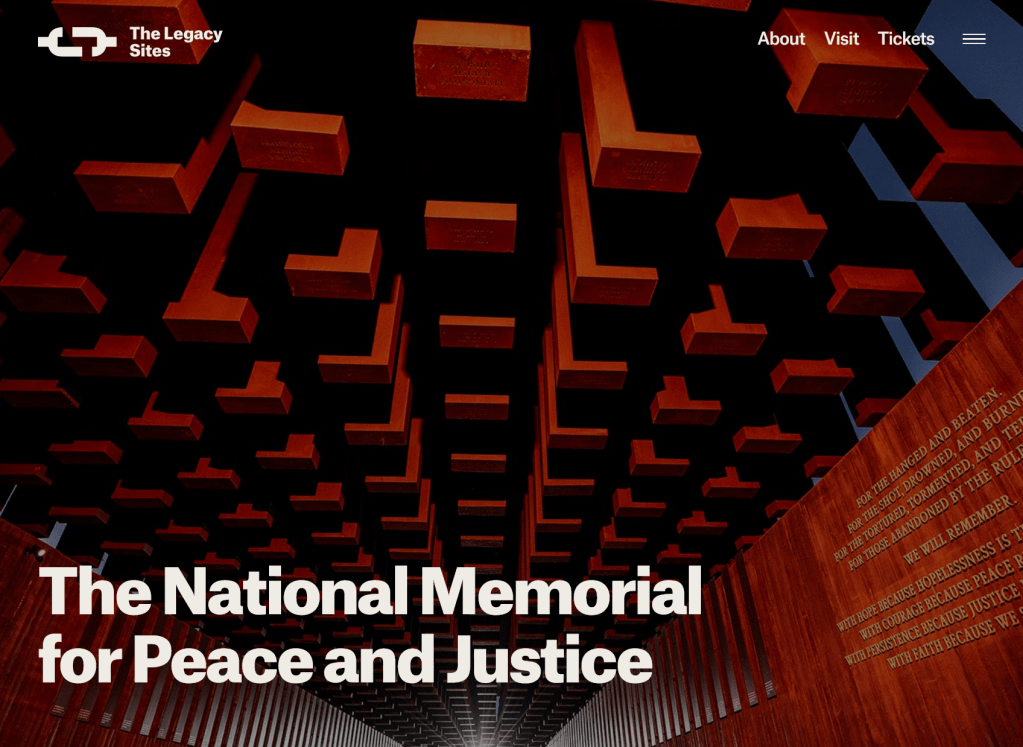
I had the privilege of travelling with a multi-racial group to Selma, Alabama, for the occasion of the 60th anniversary of the Selma bridge crossing. Part of our sojourn included a visit to the Equal Justice Initiative Lynching Memorial, https://legacysites.eji.org/about/memorial/.
When you enter the Memorial, you are admonished to show respect, similarly to how the referenced blog post admonishes us to show respect. Several of us (Black and white) peeled off to walk the grounds in solitude. A group of us (Black, as I recall) walked the grounds together. They had some youths among them, but the group as a whole (and they were not the only such group I saw that day) was basically clowning around, pretty much in apparent contravention of the preceding admonishment. (Listen to me, with my polysyllabic words.) At the time, it seemed to me to be basically disrespectful, and evidence that nothing was being learned.
I overheard a couple who appeared to be Asian, speaking to one another about the disrespect and loudness of the Black groups, a sentiment I agreed with at the time. I know nothing about them. They had no accent, and they had that easy American judgmental air, so I’m going to assume they are as American as I am. And that they had come to the Memorial with the same good intentions as I did.
But later, I was thinking. It’s a somber place, with the hanging markers. I imagine those markers both convey threat and engender anger (“rage” might be a better word), for Black visitors. In the context, Black joy might be an appropriate response. Rejection of threat. Celebration of the strength of the group. Possibly a more healthy response than rage. (I don’t know; I’m not Black. Rage is certainly justified and appropriate.) And also: who am I to assume that no learning is occurring? Humans are capable of doing more than one thing at once.
So, this constitutes a missed opportunity on my part (yet another, in a long line), for multiple reasons. (1) I hadn’t formed these thoughts at the time. (It’s worth pointing out that I might not have, were it not for this experience.) And (2) even if I had, would I have spoken to that couple? Sufficiently gently and diplomatically? (Honey versus vinegar.)
Well, I can always write a blog post. To the set of white people (including -adjacent, honorary, or otherwise) who read this blog post and find themselves at a place of Black remembrance and who see something similar (I’m guessing the cardinality of that set is just about zero, but you never know): when you see this behavior, consider chilling out. Many responses are legitimate.
«One business in the GAO report enforced a five‑day in‑office rule and saw half its workforce walk out, including top performers. In contrast, companies embracing remote options maintain low turnover and high morale.»
 Here, Read This