Author Archives: John Lusk

A white thought on Black joy (for white people)

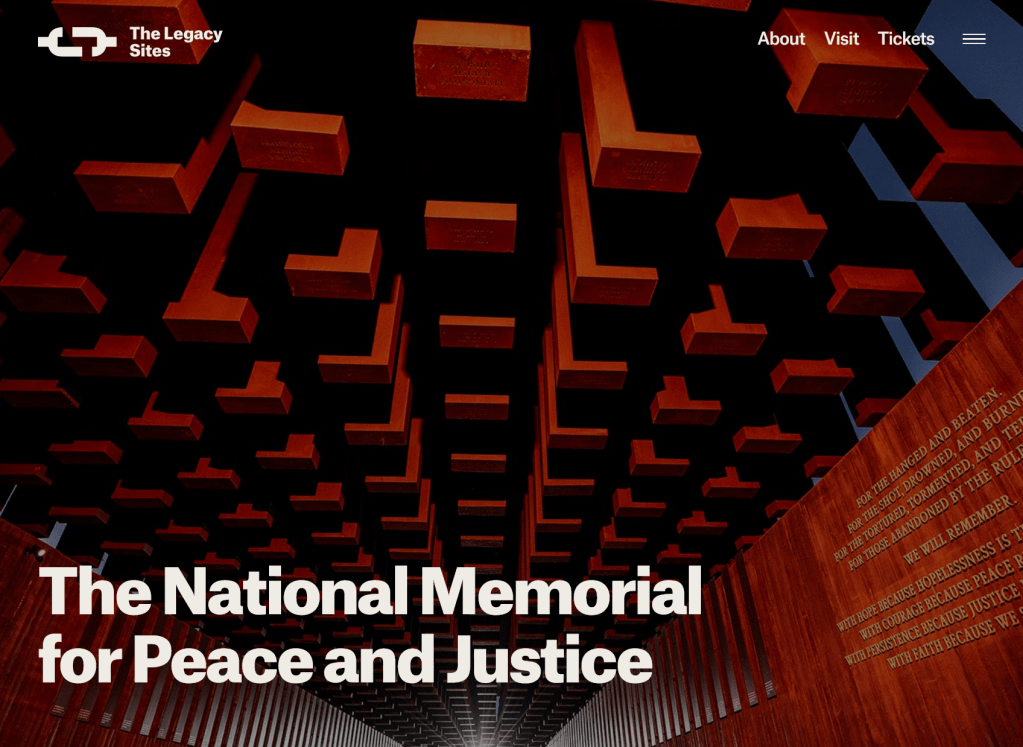
Screenshot of web page from eji.org, showing the hanging iron monuments from below in twilight.

I ran across a post on Mastodon referring to this article: https://www.ohfweekly.org/the-right-way-for-white-people/, and it had this bullet point in it:

«If you witness white folks doing problematic things, speak up with compassion to take the burden off Black folks and our siblings of color whenever appropriate. Seek to engage rather than escalate, so that it can be a learning moment rather than a disruption.»

I had a thought / was reminded of a thought I had some time ago.

I’m thinking it is the job of white people in the (global) West to do two things: (1) educate ourselves, to the best of our ability, and (2) educate each other, again, to the best of our abilities.

I had the privilege of travelling with a multi-racial group to Selma, Alabama, for the occasion of the 60th anniversary of the Selma bridge crossing. Part of our sojourn included a visit to the Equal Justice Initiative Lynching Memorial, https://legacysites.eji.org/about/memorial/.

When you enter the Memorial, you are admonished to show respect, similarly to how the referenced blog post admonishes us to show respect. Several of us (Black and white) peeled off to walk the grounds in solitude. A group of us (Black, as I recall) walked the grounds together. They had some youths among them, but the group as a whole (and they were not the only such group I saw that day) was basically clowning around, pretty much in apparent contravention of the preceding admonishment. (Listen to me, with my polysyllabic words.) At the time, it seemed to me to be basically disrespectful, and evidence that nothing was being learned.

I overheard a couple who appeared to be Asian, speaking to one another about the disrespect and loudness of the Black groups, a sentiment I agreed with at the time. I know nothing about them. They had no accent, and they had that easy American judgmental air, so I’m going to assume they are as American as I am. And that they had come to the Memorial with the same good intentions as I did.

But later, I was thinking. It’s a somber place, with the hanging markers. I imagine those markers both convey threat and engender anger (“rage” might be a better word), for Black visitors. In the context, Black joy might be an appropriate response. Rejection of threat. Celebration of the strength of the group. Possibly a more healthy response than rage. (I don’t know; I’m not Black. Rage is certainly justified and appropriate.) And also: who am I to assume that no learning is occurring? Humans are capable of doing more than one thing at once.

So, this constitutes a missed opportunity on my part (yet another, in a long line), for multiple reasons. (1) I hadn’t formed these thoughts at the time. (It’s worth pointing out that I might not have, were it not for this experience.) And (2) even if I had, would I have spoken to that couple? Sufficiently gently and diplomatically? (Honey versus vinegar.)

Well, I can always write a blog post. To the set of white people (including -adjacent, honorary, or otherwise) who read this blog post and find themselves at a place of Black remembrance and who see something similar (I’m guessing the cardinality of that set is just about zero, but you never know): when you see this behavior, consider chilling out. Many responses are legitimate.

Federal report shows remote work trumps RTO

«One business in the GAO report enforced a five‑day in‑office rule and saw half its workforce walk out, including top performers. In contrast, companies embracing remote options maintain low turnover and high morale.»

https://federalnewsnetwork.com/commentary/2025/05/federal-report-shows-remote-work-trumps-rto/#:~:text=One%20business%20in%20the%20GAO%20report%20enforced%20a%20five%E2%80%91day%20in%E2%80%91office%20rule%20and%20saw%20half%20its%20workforce%20walk%20out%2C%20including%20top%20performers.%20In%20contrast%2C%20companies%20embracing%20remote%20options%20maintain%20low%20turnover%20and%20high%20morale.

Powers and Thrones

Suddenly, this seems current:

«One reason that the label “the Dark Ages” has proven so hard to untie from the neck of the Middle Ages is that for hundreds of years—between the sixth century and the first beginnings of the Renaissance in the late thirteenth—the scientific and rational insights of the ancient world were forgotten or suppressed in the west. This was not simply an unfortunate symptom of creeping cultural dementia. It sprang from the deliberate policies of eastern emperors like Justinian, who made it their business to hound out of their world the self-appointed but unfortunately unchristian guardians of priceless knowledge.»

https://bookshop.org/ebooks/quotes/a2987e89-78e4-4fd7-8696-0d29381b5a65

“creeping cultural dementia.” ☹️

Is Trump Trying to Destroy Harvard? – WSJ

https://www.wsj.com/opinion/donald-trump-harvard-dhs-foreign-students-kristi-noem-b8ac80ed

I don’t normally wade into the comments section of anything, but it’s been interesting recently to see the responses by WSJ subscribers (including rating each others’ comments) to some stuff the Journal has posted. Top comment and top reply to that comment, at the moment:

«10h ago

WSJ editorial board: I agree that this is completely un-American and destructive of our best hopes for future prosperity and world leadership. However, your attempt at a false equivalence with the Obama administration’s attempts to reduce predation on students is absolutely disgusting. Please remember that you were the cheerleaders who helped bring on the destruction of what was once a great country. You are not idiots. You knew what you were doing.

10h ago

The Editorial Board did know what they were doing. But perhaps, they are idiots.»

I suspect I’m not the only one who thinks the WSJ editorial board is off the rails, and is refusing to let them off the hook. (I think they’ve been off the rails for decades, from the times my dad used to send me their editorials.)

Powers and Thrones

“The Huns were related in some way to a nomadic group who populated and dominated the Asian steppe as rulers of a tribal empire from the third century b.c. These nomads fought against the Chinese Qin and Han dynasties, and Chinese scribes dubbed them “Xiongnu,” or “howling slaves.” The name stuck, and was transliterated as Xwn or Hun.” – Powers and Thrones (Dan Jones) https://bookshop.org/ebooks/quotes/a73bc9f0-c623-4e46-a134-f601d5b2a766

Hungary.

You’re welcome.

Powers and Thrones

“Nevertheless, in around 395 he broke off friendly relations with Rome’s leaders and had himself elected king of a Gothic coalition now known as the Visigoths. ” – Powers and Thrones (Dan Jones) https://bookshop.org/ebooks/quotes/5d6416f2-7760-481c-a6f8-85cd6b842b1d

Elected. I don’t care how corrupt or limited the election was, this was a pirate captain getting voted into power by his peers.

800 years before the Magna Carta* we’re so proud of. The ancient Greek democracy turns out to have been pretty widespread, I guess, not some pure, heroic ideal in a shining city on a hill.

*Another pirate captain getting restricted by his peers. Actually, I guess I’ll be reading about it in this book.

Powers and Thrones

“When the Huns arrived north of the Black Sea in the 370s, they had displaced the Goths. Now, as they swept into the Great Hungarian Plain, they disrupted other barbarian groups: Alans, Vandals, a Germanic people known as the Suevi ” – Powers and Thrones (Dan Jones) https://bookshop.org/ebooks/quotes/59bb18d4-8c21-43af-8b30-6445c2b33f64

My grandfather’s people! The Schwebisch! (Or is that a dialect? I forget.) Living in Schwabenland, known to the rest of you heathens as Bavaria.

And, yes, as I write this, I am aware that there are those whose people come from Ghana, Nigeria, the Congo, etc., who don’t know for sure, because there’s a brick wall.

We are all descended from emperors and horse thieves. (Dammit, I just realized that’s kind of a male image. Stupid monkey brain.)

Powers and Thrones

“Disputes between Roman citizens—veteran soldiers who had settled in the province, for example—would be subject to Roman law. Cases between noncitizens might be left to the preexisting laws of the land, allowing the community to keep hold of an important measure of self-determination.” – Powers and Thrones (Dan Jones)

https://bookshop.org/ebooks/quotes/f90718b3-a6ab-4f13-be29-0a0e1edfb09a

I guess this is how Jesus got turned over to the ancient Israelites? I think I’m missing something, because he still wound up crucified.

Ah. He didn’t actually get turned over. What was I thinking?

«Luke 23:13-25 (NRSVue)
Pilate then called together the chief priests, the leaders, and the people and said to them, “You brought me this man as one who was inciting the people, and here I have examined him in your presence and have not found this man guilty of any of your charges against him. Neither has Herod, for he sent him back to us. Indeed, he has done nothing to deserve death. I will therefore have him flogged and release him.”,
Then they all shouted out together, “Away with this fellow! Release Barabbas for us!” (This was a man who had been put in prison for an insurrection that had taken place in the city and for murder.) Pilate, wanting to release Jesus, addressed them again, but they kept shouting, “Crucify, crucify him!” A third time he said to them, “Why, what evil has he done? I have found in him no ground for the sentence of death; I will therefore have him flogged and then release him.” But they kept urgently demanding with loud shouts that he should be crucified, and their voices prevailed. So Pilate gave his verdict that their demand should be granted. He released the man they asked for, the one who had been put in prison for insurrection and murder, and he handed Jesus over as they wished.»