Interesting article showing some of the thinking involved.
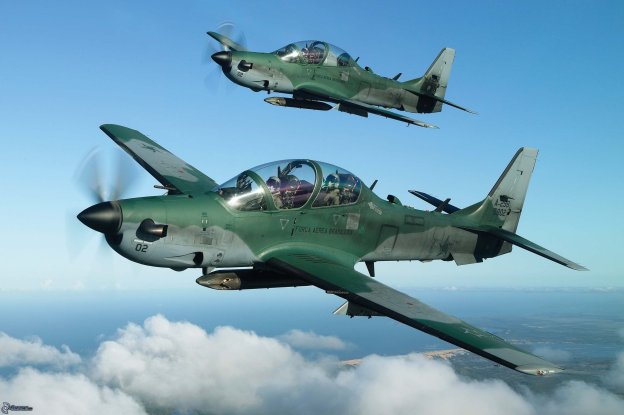
With this background, can the introduction of light attack aircraft provide battlefield capability and fiscal relief? In some ways, the answer seems to be a clear yes. Among manned systems operated in permissive environments, the A-29 and Scorpion clearly deliver ordnance at the lowest possible cost. The low operating cost of these airplanes allow for one thousand pounds of ordnance to be delivered for slightly over $300 per operating hour (See Table A). Only heavy bombers, capable of delivering tens of thousands of pounds of bombs at a time even come close to the cost per 1000 pounds of ordnance delivered. Fifth generation aircraft such as the F-22 and F-35 perform poorly in this metric, making the adoption of inexpensive light attack aircraft to supplement their numbers particularly attractive.
This is not to say that a light attack aircraft is not without flaws. Most obviously, in order to achieve low operating costs a light attack plane gives up other capabilities. Stealth, speed, and sensor integration all suffer to various extents in relatively inexpensive aircraft. An A-29 will simply not arrive on station as quickly as an F-15, survive contested airspace like an F-22, or have the situational awareness of an F-35; nor does it need to. A key design feature of light attack aircraft is the ability to operate from austere airbases. Both the A-29 and AT-6 have demonstrated this ability, allowing them to refuel, replenish, and respond from forward locations and arrive at the fight quickly, without the need for high speed.
 Here, Read This